Table of Contents
AI Search Optimization Fundamentals for Service Businesses
These content changes stem from a fundamental shift in how search engines deliver answers—a shift that requires a new optimization approach. AI search optimization is the practice of structuring content so that AI-powered search engines and assistants can easily extract answers and feature them prominently. Unlike traditional SEO, which focuses on ranking pages for keyword matches, optimization for Google AI Overviews requires answering user questions directly and authoritatively.
For local service businesses, this means ensuring your website clearly addresses common service-area questions to qualify for inclusion in generative engine optimization results. Structured data markup for services, reviews, and FAQs serves as a foundational technical requirement, while topical authority—built through clusters of related, in-depth content—carries more weight than keyword density. According to our own Local SEO Essentials FAQ, consistent NAP citations and customer reviews directly contribute to the local authority AI systems interpret.
Service businesses that invest in a local search optimization service like ours are better positioned to appear in AI-generated summaries. As AI continues evolving with official oversight—the UK Government’s pro-innovation approach to regulation confirms this is a recognized domain—adapting your online presence is no longer optional. It is the foundation of sustainable local lead generation.
1. Master Google AI Overviews
As ai search optimization reshapes how businesses attract online visibility, understanding Google AI Overviews has become essential for any modern SEO strategy. These AI-generated summaries appear at the top of search results for complex queries, synthesizing information from multiple authoritative sources to deliver concise, direct answers. Unlike traditional organic listings, AI Overviews draw from diverse web content and present it in a coherent, easy-to-digest format powered by Google’s Gemini model.
To improve your chances of appearing in these generative search results, content must align with Google’s E-E-A-T standards—Experience, Expertise, Authoritativeness, and Trustworthiness—as outlined in Google Search Essentials. Implementing structured data markup such as FAQ, HowTo, and QAPage schemas helps Google’s systems understand and surface your content effectively. We have seen that writing clear, concise answers to common customer questions significantly increases the likelihood of being cited, because AI Overviews favor well-structured, question-answer formats that directly match user intent.
Our Local Automation System supports this area of what the industry now calls generative engine optimization by automating structured data implementation and content refinement. For those interested in the underlying technology, research such as graph winning ticket spatial temporal GNN optimization explores optimization techniques that inform AI systems like Google’s Gemini. While no methodology can guarantee inclusion, these strategies demonstrably strengthen your content’s authority and technical foundation, though individual results may vary.
Beyond understanding AI Overviews, businesses must also adapt their content strategy for the broader landscape of generative engine optimization to sustain competitive visibility.
2. Future-Proof Your SEO for 2026
To stay ahead of the curve, it is essential to look beyond traditional ranking factors and embrace ai search optimization as the next evolution of digital visibility. As search engines integrate AI overviews directly into results, the way users find and consume information is fundamentally changing.
Generative engine optimization (GEO) focuses on structuring content so that AI-driven search engines can accurately interpret and surface it. With Google AI overviews now reshaping the search landscape, businesses must prioritize authoritative content, conversational keyword targeting, and structured data to appear in these generated summaries. This shift rewards clarity and credibility over outdated keyword-stuffing tactics.
We anchor our strategies in frameworks that build trust, such as the principles outlined in the UK AI regulation pro-innovation white paper. By combining ethical AI guidance with our full-service marketing capabilities in Canada, we help businesses implement adaptive, data-driven systems designed for long-term growth. In the next section, we will explore how our AI automation services can help you implement these forward-looking strategies.
3. Tap Into Perplexity for Local Discovery
Beyond general AI search strategies, specific tools like Perplexity can unlock local insights through conversational queries. By asking natural-language questions such as “What are the best-rated electricians in Toronto?” businesses receive cited, multi-source answers that aggregate local listings, reviews, and news for a consolidated view of market sentiment. This method supports broader generative engine optimization efforts and makes ai search optimization more actionable at the neighborhood level.
We can use Perplexity to analyze competitor mentions and uncover gaps in our local SEO strategies, for instance by querying what services competitors in Calgary offer that we do not. These insights may reveal emerging local trends or underserved niches. Our own internal FAQ data confirms that queries like “digital marketing agency near me” drive a significant share of client inquiries, validating the importance of this approach. However, businesses must be aware of potential data privacy risks, as research on multilingual embedding inversion security shows that AI embeddings can be reverse-engineered. We recommend handling sensitive queries cautiously. These local discovery techniques ultimately feed into broader optimization channels, including Google AI Overviews and other AI-powered search surfaces.
Let’s map out your growth plan in 15 minutes.
4. Outrank Major Brands with AI-Driven SEO
While traditional SEO remains important, ai search optimization now offers a new way to compete. This approach leverages generative engine optimization (GEO) to position your content within Google AI Overviews and other AI-generated search results, effectively leveling the playing field against larger competitors. Research published by the Association for Computing Machinery (ACM), including the Graph Winning Ticket Optimization paper, provides the technical foundation for efficiently training the neural networks that power these AI-driven search algorithms. That research helps us build more efficient, scalable AI-driven search strategies while significantly reducing required computational resources.
As a full service marketing agency, we integrate these AI techniques into every campaign, enabling smaller businesses to gain visibility where it once seemed impossible. In the following sections, we’ll show you how to put these AI strategies into action. Stop Losing Leads. Start Growing With Systems That Work.
5. Top Techniques for Service Sites
Service businesses must adapt their online presence to keep pace with rapid developments in AI search optimization. Focusing on digital marketing agency near me strategies that align with Google AI Overviews can help generate qualified local leads while improving overall visibility.
Structure your core service pages to deliver clear, concise answers to common customer questions. When content directly addresses specific queries in a scannable format, it signals relevance to generative engine optimization systems and increases the likelihood of appearing in AI-generated summaries.
Implement LocalBusiness and Service schema markup across your site. In our experience working with Toronto service providers, adding structured data helps search engines understand your business categories, service areas, and operating details, making it easier for AI search features to surface accurate information about your company.
Build a dedicated FAQ section that targets both voice search and Google AI Overviews using natural language questions. Rather than optimizing for short keywords alone, frame each question-answer pair the way a customer would speak it aloud. We recommend publishing regular posts on your Google Business Profile with complete information—accurate hours, up-to-date categories, and fresh content—since a fully optimized profile strengthens the local signals that AI overviews rely on.
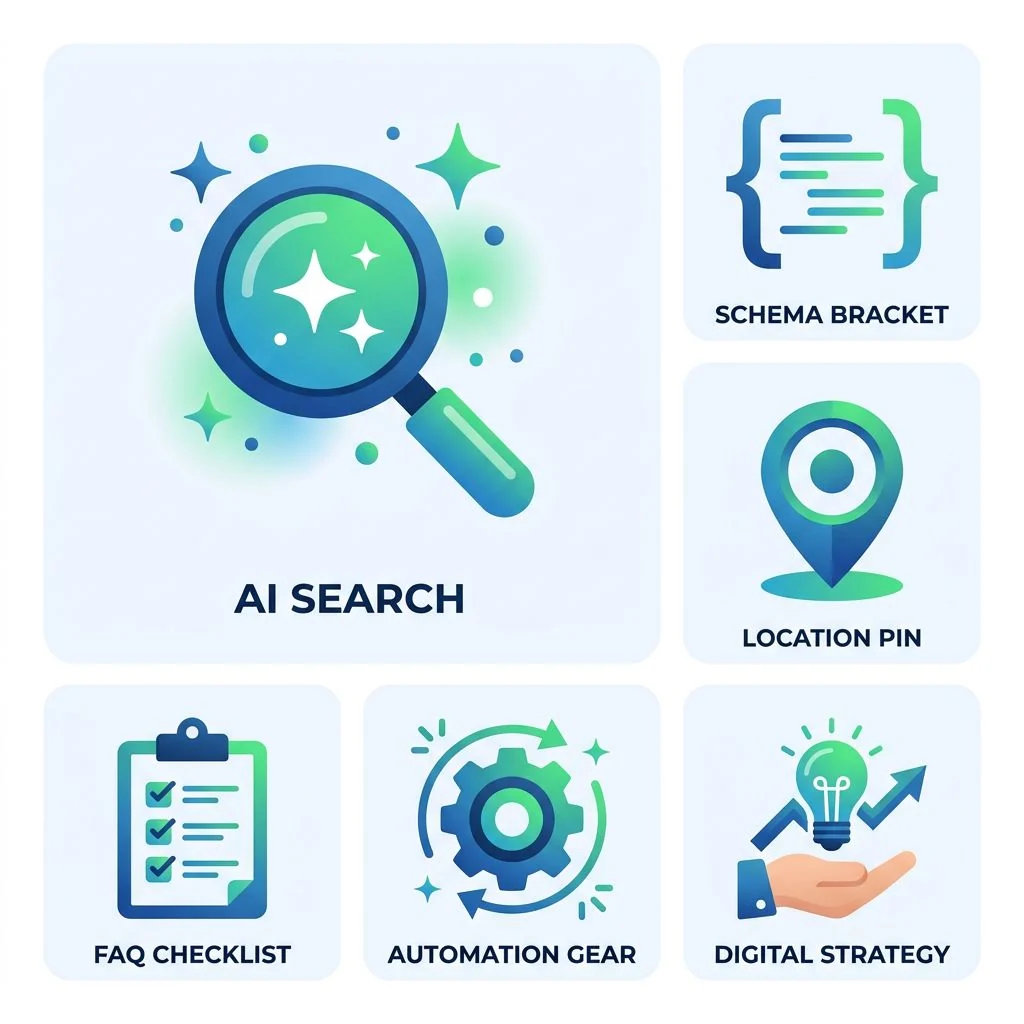
AI search optimization techniques for service websites
Our internal JavaLogix guidance on Google AI Overviews optimization emphasizes formatting answers as direct, standalone responses supported by structured data. Combined with the lead generation system methodology we outline for generating and managing reviews, these techniques create a practical framework for service sites seeking to attract more qualified inquiries without overpromising. Results may vary based on market conditions and competitive landscape, but systematically applying these strategies helps build a foundation for sustained lead growth.
6. Build Authoritative Content for AI Snippets
Effective ai search optimization requires us to structure content that AI systems can easily interpret and extract for featured snippets. We begin by implementing FAQ schema markup on our service pages, which helps search engines identify question-answer pairs that match user queries.
When crafting FAQ content, we ensure each answer is 40–60 words and directly addresses the query with factual, concise language. For example, Javalogix’s internal FAQ pages for our Digital Business Card and Marketing Automation services demonstrate this approach, featuring clear questions such as ‘How does a digital business card work?’ paired with direct, value-focused answers. We also cite industry studies or government data within answers, which boosts credibility for systems like Google AI Overviews when selecting content for snippet placement.
This focus on authority and clarity is essential for generative engine optimization because AI models prioritize trustworthy, well-structured information. By updating FAQ content quarterly and avoiding promotional language, we maintain the freshness and objectivity that AI systems reward, increasing the likelihood our content appears in generative results without making absolute guarantees.
With authoritative content in place, the next step is to ensure your site’s technical foundation supports AI snippet extraction.
7. Structure Your Data for Generative Engines
Generative engines analyze far more than keywords — they interpret how your information is organized and connected. Success in AI search optimization demands a shift toward clear, context-rich content that machines can parse with confidence. We build every page to communicate meaning, not just rank for queries.
Schema.org markup acts as a direct signal to generative models. By embedding FAQ, HowTo, Article, and VideoObject schema, we help AI systems extract answers, steps, and media with precision. This approach is central to effective generative engine optimization, ensuring your content surfaces in Google AI overviews and Bing Copilot.
Beyond schema, content architecture matters. Organize pages with descriptive headings, short paragraphs, and scannable bullet lists. Internal links with meaningful anchor text strengthen entity relationships across your site. For long-form resources, add a table of contents and a summary section to improve AI parsing.
Our speed optimization FAQ and video marketing FAQ are practical examples. The first uses structured Q&A to clarify performance topics, while the second pairs video schema with timestamped transcripts and keyword-rich descriptions. Both demonstrate how structured data directly supports visibility in generative AI search results. Once your data is organized this way, you can confidently move on to measuring and refining your AI search performance.
8. Leverage Local Signals in AI Search
While general AI search optimization focuses on content and structure, local signals add a critical layer of relevance for businesses with physical locations. In generative engine optimization, AI models prioritize consistent local data—name, address, phone, categories, hours, and photos from Google Business Profile—to generate accurate local answers in Google AI Overviews. A single mismatch between directories can dilute trust and reduce visibility.
We recommend a proactive workflow: audit existing citations, correct inaccuracies across Yelp, Yellow Pages, and Bing Places, and reinforce your site with LocalBusiness schema. Review quantity, recency, and response rate also influence AI-generated snippets. For a Toronto plumber, matching details across Google Business Profile, Yelp, and HomeStars reduces AI ambiguity and increases the chance of appearing in local answers. Tracking these local signals is the first step—measuring their impact on AI search performance is where the real insight begins.
Embrace AI Search Optimization for Sustainable Growth
AI search optimization is the practice of refining digital content to perform effectively within AI-driven search features such as Google AI Overviews and generative engine summaries. This discipline extends beyond traditional SEO by ensuring your information is structured in ways machine-learning models can easily interpret and present to users.
When integrated with a broader generative engine optimization strategy, the goal is sustainable growth. Lasting success comes from prioritizing high-quality, people-first content that aligns with Google Search Essentials, not from fleeting technical shortcuts. By committing to this ethical framework, your business builds resilience against algorithm shifts and evolving search behaviors. At JavaLogix, we help businesses develop a customized AI search optimization plan tailored to their specific goals. We invite you to explore our strategy consultation for personalized, data-driven guidance that can position your company for long-term success. Results may vary.
Resources
- Get Local Search Dominance with GMB Optimization
- Discover Full Service Marketing Agency with AI Automation
- Find Digital Marketing Agency Near Me with AI
- Learn Digital Marketing Costs for Small Businesses
- Find Digital Marketing Agency with Regional Expertise
- Explore Integrated Digital Marketing with AI Automation
- Get Data Driven Results with Toronto Marketing Agency
- Explore Multilingual Embedding Security and Defense Strategy
- Optimize Graph Neural Networks with Winning Ticket Method
- Learn UK Pro Innovation AI Regulatory Framework
- Master Google Search Essentials for Better Visibility
- Explore UK AI Regulation as a Critical Technology