You’re invisible. Even though you’re the best at what you do, Google is currently treating your business like a ghost. While you watch competitors—many of whom provide inferior service—dominate the Local Pack for "near me" searches, your business remains buried on page three.
It is a common misconception that ranking #1 requires a massive advertising budget. In reality, local visibility is determined by technical ranking signals rather than total spend. If you want to stop losing leads to the guy down the street, you need to implement three technical "blueprints" that take less than 15 minutes to execute.
The "Primary Category" Trap: Why Being a Jack-of-All-Trades is Killing Your Rank
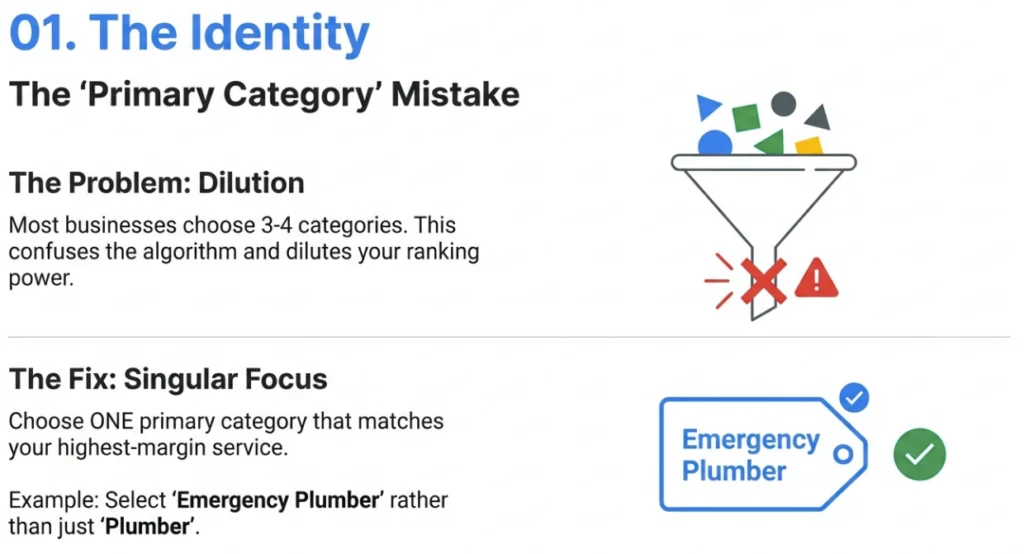
Most business owners attempt to cast the widest net possible by selecting four or five different business categories in their profile. They think it makes them more searchable; the algorithm thinks it makes them irrelevant. This "jack of all trades" approach dilutes your ranking authority and confuses Google’s ability to categorize your expertise.
To fix this, you must prioritize one primary category that aligns with your highest-margin service.
- The Blueprint: Instead of the broad "Plumber" designation, a business focusing on high-value, urgent calls should select "Emergency Plumber."
- Strategic Analysis: The trade-off is simple: while the total search volume for "Emergency Plumber" is smaller than the generic term, the conversion intent is exponentially higher. By being specific, you stop thinning out your ranking power and start signaling to the algorithm that you are the definitive authority for that specific, high-margin need.
The Photo Geo-Tag Hack: Metadata as "Proof of Work"
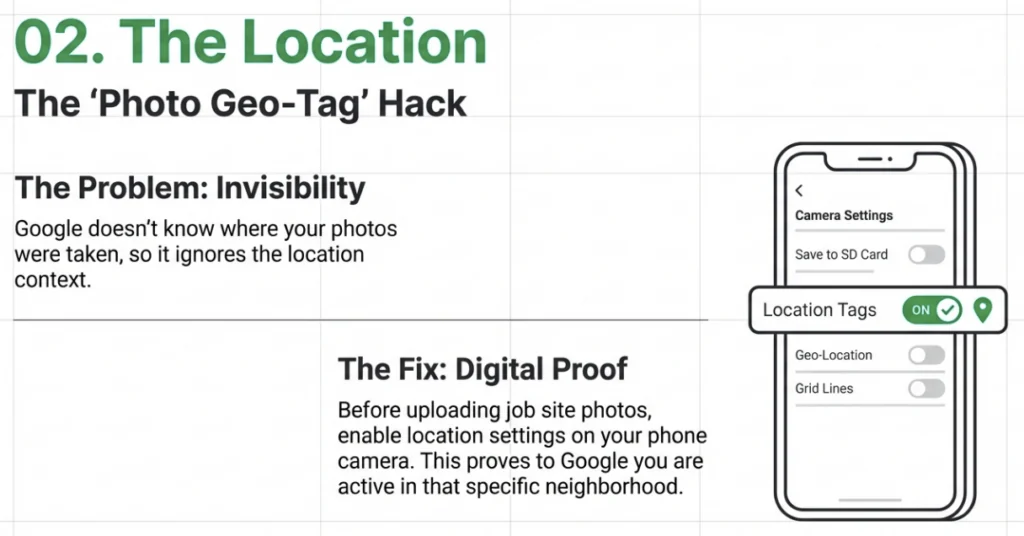
Google is obsessed with proximity and authenticity. It wants to show users businesses that are truly active in their local neighborhoods, but it lacks the inherent knowledge to know where your job site photos were taken. If you are uploading static images without location data, you are failing to provide "neighborhood proof."
- The Blueprint: Before taking and uploading job site photos to your profile, ensure the location settings (geo-tagging) are enabled on your phone’s camera.
- Strategic Analysis: While Google’s Vision AI is sophisticated enough to recognize objects in an image, it relies on GPS metadata to anchor those images to a physical coordinate. This "proof of work" validates your service area in a way that static text cannot. It’s an insider move that beats competitors who rely on lazy stock photos or unoptimized uploads.
The 24-Hour Rule: Turning Latency into Local Dominance
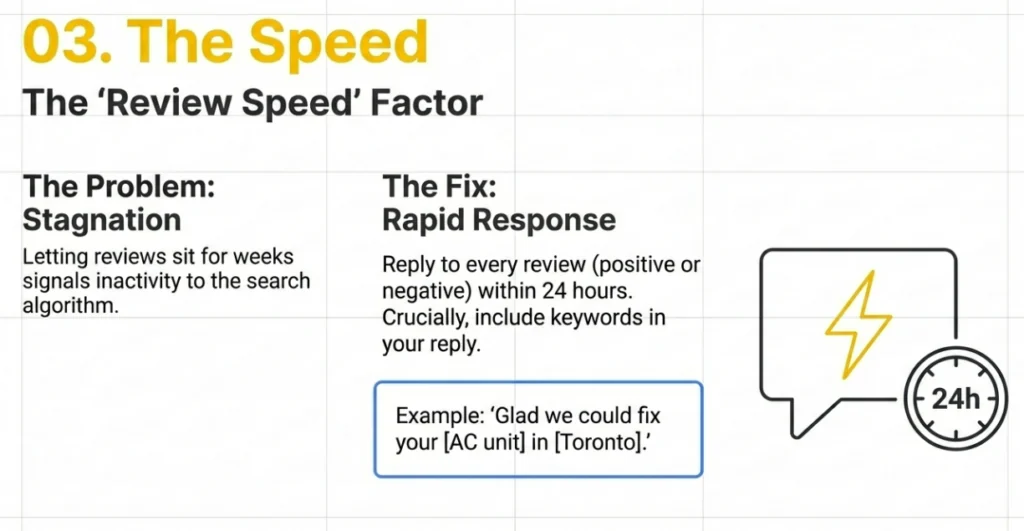
Many businesses treat customer reviews as a weekly chore, letting feedback sit for days or weeks. This latency is a massive missed opportunity. Review response speed is a critical engagement signal that tells Google your business is active and responsive.
- The Blueprint: Reply to every single review—positive or negative—within a 24-hour window.
- The Tweak: Never send a generic "thank you." Instead, use the response as an indexing signal by naturally integrating keywords. For example: "It was a pleasure to help you fix your AC unit in Toronto today."
- Strategic Analysis: This isn’t just about customer service; it’s about SEO. By mentioning the service and location in your reply, you are providing the algorithm with additional confirmation of your business's relevance to that specific geographic search.
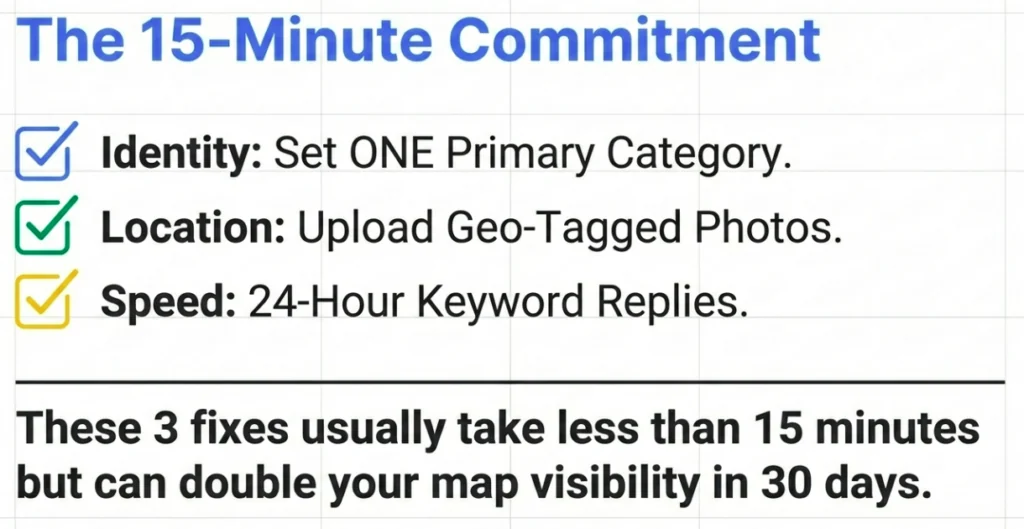
"These 3 fixes usually take less than 15 minutes but can double your map visibility in 30 days."
The 30-Day Transformation
Achieving local dominance isn't about a complex overhaul; it’s about high-impact, low-effort adjustments. By narrowing your primary category, enabling location metadata on original job site photos, and crushing the 24-hour response window, you address the exact signals that drive the local algorithm.
Your competitors are gaining ground every minute you remain "invisible." In the next 15 minutes, which of these three errors will you kill first to ensure your business finally shows up where your customers are looking?